The cryptocurrency industry has spent more than a decade asking for one thing above all else: regulatory clarity. While blockchain technology has evolved rapidly, the legal framework governing digital assets in the United States has often lagged behind. Questions surrounding whether cryptocurrencies should be regulated as securities or commodities have created uncertainty for developers, investors, exchanges, financial institutions, and blockchain companies alike.
The Digital Asset Market CLARITY Act (H.R. 3633) seeks to change that.
As one of the most comprehensive pieces of cryptocurrency legislation introduced in Congress, the CLARITY Act is designed to establish a modern regulatory framework for digital assets while promoting innovation, protecting investors, and strengthening America’s leadership in blockchain technology.
With the legislation now having passed the House of Representatives and officially placed on the U.S. Senate Legislative Calendar, many investors are asking the same question:
What is the current status of the CLARITY Act, and what happens next?
What Is the Digital Asset Market CLARITY Act?
Introduced by Representative J. French Hill (R-Arkansas) on May 29, 2025, the Digital Asset Market CLARITY Act (H.R. 3633) aims to establish clear rules governing digital assets in the United States.
For years, cryptocurrency companies have operated under a patchwork of regulations that frequently left projects uncertain about which federal agency had jurisdiction over their digital assets.
One of the bill’s primary objectives is to clearly define when a digital asset should be regulated by the Securities and Exchange Commission (SEC) and when oversight should instead fall under the Commodity Futures Trading Commission (CFTC).
Supporters believe that eliminating this uncertainty will encourage responsible innovation while maintaining strong consumer protections.
Why Regulatory Clarity Matters
Few industries have experienced as much regulatory uncertainty as cryptocurrency.
Since Bitcoin’s launch in 2009, blockchain technology has expanded into decentralized finance (DeFi), tokenized assets, NFTs, staking, stablecoins, decentralized infrastructure, and enterprise blockchain applications.
Despite billions of dollars flowing into the sector, many companies have struggled with one fundamental question:
Which federal regulator oversees their digital assets?
Without clear legal definitions, businesses have often relied on legal opinions, enforcement actions, and court decisions rather than explicit legislation.
This uncertainty has resulted in:
- Delayed investment decisions
- Higher legal and compliance costs
- Companies relocating operations outside the United States
- Reduced institutional participation
- Conflicting interpretations between regulators
The CLARITY Act seeks to replace uncertainty with clearly defined statutory rules.
Key Objectives of H.R. 3633
Although the legislation is detailed and technical, its major goals are relatively straightforward.
The CLARITY Act seeks to:
- Establish legal definitions for digital assets.
- Clarify the jurisdiction of the SEC and CFTC.
- Create standards for determining when blockchain networks become sufficiently decentralized.
- Require disclosures from digital asset issuers during transitional periods.
- Strengthen consumer protections while encouraging innovation.
- Promote regulatory consistency across digital asset markets.
Many industry participants believe these reforms would make the United States significantly more competitive in blockchain development.
Current Status of the CLARITY Act
The legislation has advanced further than most cryptocurrency bills introduced in previous congressional sessions.
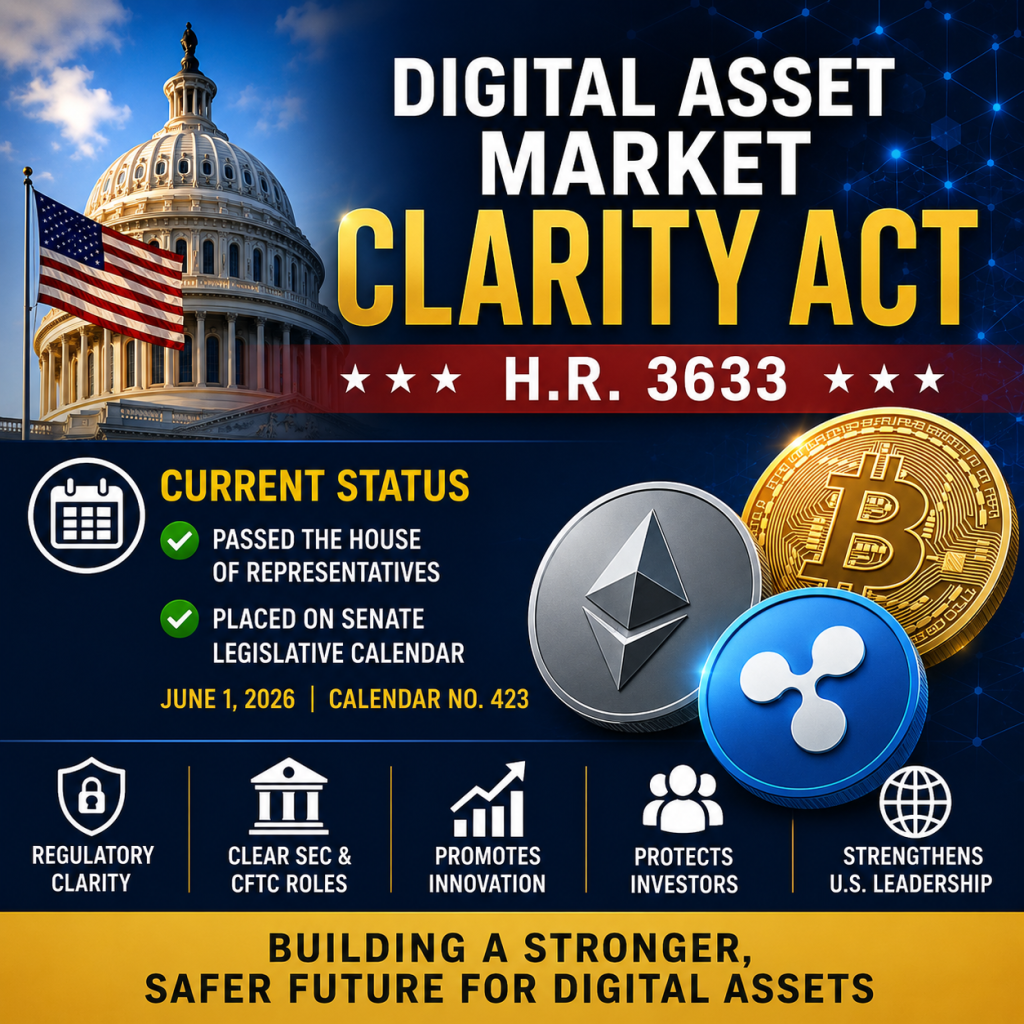
After extensive review by both the House Financial Services Committee and the House Agriculture Committee, H.R. 3633 successfully passed the House of Representatives.
The next major milestone occurred on June 1, 2026, when the bill was officially placed on the U.S. Senate Legislative Calendar under General Orders as Calendar No. 423.
This is an important procedural step.
Placement on the Senate Legislative Calendar means the bill is eligible for consideration by the full Senate.
However, many people misunderstand what this status means.
Being placed on the Senate Legislative Calendar does not automatically schedule a Senate vote.
Instead, Senate leadership determines when—and if—the legislation will be brought to the Senate floor.
At the time of writing, no official Senate floor vote has been scheduled.
What Happens Next?
Several important legislative steps remain before the CLARITY Act can become law.
1. Senate Consideration
The Senate must first decide to bring H.R. 3633 to the floor.
During debate, senators may propose amendments that modify portions of the legislation.
2. Senate Vote
If approved by the Senate exactly as passed by the House, the bill proceeds directly to the President.
If amended, the House and Senate must reconcile differences before final approval.
3. Presidential Signature
Once both chambers approve identical language, the legislation is sent to the President for signature.
Only then does the CLARITY Act officially become law.
Why Investors Are Paying Attention
The CLARITY Act has attracted significant attention from cryptocurrency investors because regulatory clarity has long been viewed as one of the industry’s largest obstacles.
Institutional investors often require predictable legal frameworks before committing substantial capital.
Banks, pension funds, investment advisers, and publicly traded corporations generally prefer operating within well-defined regulatory environments.
If enacted, the legislation could encourage:
- Increased institutional participation
- Greater venture capital investment
- More blockchain development within the United States
- Expanded financial innovation
- Improved market confidence
While legislation alone cannot guarantee market appreciation, regulatory certainty has historically encouraged long-term investment across many industries.
Potential Impact on Bitcoin, Ethereum, XRP, Flare, and Other Digital Assets
The CLARITY Act does not designate specific cryptocurrencies as securities or commodities.
Instead, it establishes regulatory principles and processes for determining appropriate oversight.
Projects operating decentralized blockchain networks could benefit from greater legal certainty regarding their regulatory status.
Networks supporting staking, decentralized finance, smart contracts, decentralized infrastructure, and enterprise blockchain applications may particularly benefit from a more predictable regulatory environment.
For digital assets such as Bitcoin, Ethereum, XRP, Flare, and many others, the legislation represents an important step toward reducing legal ambiguity—even though each asset’s treatment would continue to depend on the facts and applicable law.
Challenges Facing the Legislation
Although the bill enjoys bipartisan interest, it still faces important hurdles.
Some lawmakers believe stronger consumer protections should accompany broader regulatory reforms.
Others continue to debate:
- SEC authority
- CFTC oversight
- Stablecoin regulation
- Decentralized finance
- Investor disclosures
- Market integrity requirements
These discussions may result in amendments before any final Senate vote.
Legislative negotiations are a normal part of the congressional process, particularly for complex financial legislation.
Why This Bill Is Different
Previous cryptocurrency legislation often focused on individual issues such as stablecoins, taxation, or consumer protection.
The CLARITY Act is broader.
It attempts to establish an overall regulatory framework rather than addressing a single segment of the digital asset industry.
For many observers, this represents the most comprehensive attempt yet to modernize federal cryptocurrency regulation.
Outlook for 2026
The CLARITY Act is currently positioned better than nearly any previous crypto market structure bill.
Its passage through the House demonstrates meaningful congressional support.
Placement on the Senate Legislative Calendar confirms that the legislation has moved into the Senate phase of the legislative process.
However, significant uncertainty remains regarding timing.
Senate leadership has not announced a floor debate or voting schedule.
Congressional priorities, budget negotiations, appropriations legislation, and other national issues may influence when crypto legislation receives consideration.
Even so, many industry analysts view the bill’s current status as encouraging.
What the Crypto Industry Should Watch
The next several developments will be especially important:
- Announcement of a Senate floor debate.
- Senate amendments to H.R. 3633.
- Public statements from Senate leadership.
- Committee recommendations or additional negotiations.
- Final Senate passage.
- Presidential action.
Each of these milestones would move the legislation one step closer to becoming law.
Final Thoughts
The Digital Asset Market CLARITY Act represents one of the most important cryptocurrency regulatory proposals ever considered by the United States Congress.
After years of uncertainty surrounding digital asset regulation, H.R. 3633 offers a framework intended to clarify oversight, encourage innovation, strengthen investor protections, and improve America’s competitiveness in blockchain technology.
The legislation has already achieved significant progress by passing the House of Representatives and being placed on the Senate Legislative Calendar. While a Senate vote has not yet been scheduled, the bill is now positioned for potential consideration by the full Senate.
Whether enacted in its current form or modified through the legislative process, the CLARITY Act has become a focal point for investors, blockchain companies, financial institutions, and policymakers alike.
As the debate continues, one thing is clear: the future of cryptocurrency regulation in the United States may be shaped by the outcome of H.R. 3633. Investors and industry participants alike will be watching closely as Congress determines the next chapter in the evolution of digital asset regulation.
Leave a Reply